


I have been sitting at the intersection of creativity and technology for the last ten years, watching the evolution of the web from static sites to dynamic online spaces. The question that has always driven my leadership at Directions Solutions is: How can we make the online experience more human?
In my experience, our company has evolved from simple automation to a point where AI actually improves our instincts, allowing us to cut our technical debt and timeline in half while opening up new avenues for deep creativity. I would like to explore how these shifts are manifesting in the form of observable trends in this article. The following ten trends represent where we are headed in 2026, whether you are running a business or building the next generation of the internet.
Why AI is Transforming Web Design
The demand for smarter, more flexible online platforms is driving trends in AI web design. AI-powered tools that analyze user behavior in real-time are replacing traditional design techniques. AI has been used at Directions Solutions to cut design timelines by as much as 50%, giving designers more creative freedom. Our company’s job is to lead these changes by utilizing AI to create custom web solutions that improve user engagement and conversion rates.
Trend 1: Hyper-Personalized User Interfaces
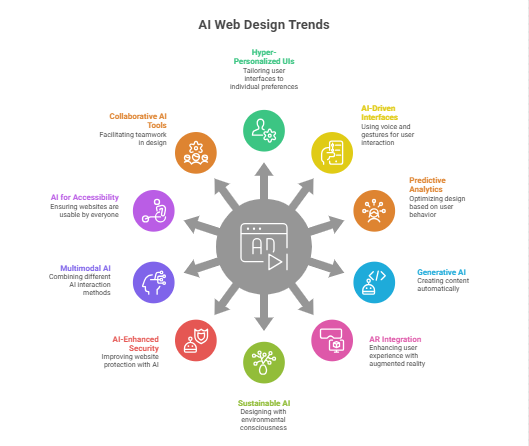
Hyper-personalization, in which websites dynamically adjust to each user, is one of the most fascinating trends in AI web design. At Directions Solutions, we’re creating the future of websites that adapt their layouts according to user browsing history.
How AI Enables Personalization
Large data sets are processed by AI algorithms to forecast user preferences, allowing for smooth navigation, color, and content adjustments. By giving users a sense of exclusivity, this trend increases user retention. AI will increase sales in e-commerce by curating product recommendations in real-time. Similar implementations have increased conversions for our clients by 30% which was amazing.
Challenges and Solutions
Such extensive data use raises privacy issues, but moral AI procedures, such as those we support at Directions Solutions, guarantee adherence to laws like GDPR. Our goal is to use data in a transparent manner that benefits users without jeopardizing their security.
Trend 2: AI-Driven Voice and Gesture Interfaces
Among the most popular AI web design trends are voice search and gesture controls, which enhance the naturalness of interactions. In my role as CEO, I see websites that can react to hand gestures or spoken commands, improving accessibility for all.
Integrating Voice AI
Sites can comprehend and react to voice inputs thanks to tools like natural language processing (NLP), which is ideal for mobile users who are constantly on the go. AI will use webcams to interpret gestures by 2026, allowing touchless navigation—perfect for augmented reality or public kiosks.
Benefits for User Experience
This trend fits with Directions Solutions’ inclusive design philosophy by lowering friction, particularly for users with disabilities. Making the internet accessible is a duty, not merely a fad.
Trend 3: Predictive Analytics for Design Optimization
With its ability to predict user needs and optimize layouts before problems ever arise, predictive AI is revolutionizing AI web design trends.
Data-Driven Predictions
AI examines traffic trends to recommend design changes, like moving Call-to-Action (CTA) buttons to improve click-through rates. The days of manual testing are over; at Directions Solutions, we’ve mastered AI to run simulations that save time and money.
Future Implications
Anticipate AI to develop designs on its own, guaranteeing that websites stay current with shifting trends without needing a total redesign every two years.
Trend 4: Generative AI for Content Creation
With the ability to generate text, images, and even code on demand, generative AI tools are exploding in AI web design trends. Prototyping can be greatly accelerated by designers using prompts to create unique graphics.
Dynamic Content Generation
In order to maintain content freshness without constant human intervention, websites will automatically populate blogs or product descriptions. As CEO, I stress responsible AI use to prevent plagiarism, emphasizing augmentation over replacement. For emotional resonance and brand voice, the human touch is still essential.
Trend 5: Augmented Reality (AR) Integration via AI
An innovative trend that transforms static websites into immersive experiences is the combination of AR and AI. With browser-based augmented reality, users can see products in their surroundings without the need for apps.
Enhancing E-Commerce
At Directions Solutions, we have created AR capabilities that increase purchase confidence by 40 percent. AI optimizes AR for low-bandwidth devices, allowing all users to enjoy high-end AR capabilities regardless of their hardware.
Trend 6: Sustainable AI Design Practices
Sustainability is an important factor in the AI web design trends of 2026. AI is now being applied to reduce energy consumption in web activities.
Eco-Friendly Optimization
AI optimizes data by compressing assets and simplifying code, reducing server and carbon footprints. We advise our clients on AI-supervised green data centers at https://directions.solutions/. Soon, software will monitor the environmental impact of a site in real-time, encouraging eco-friendly design practices as the norm rather than the exception.
Trend 7: AI-Enhanced Security Features
Security is essential, and AI web design trends feature predictive threat protection. AI detects threats and protects against them before they occur.
Biometric Authentication
Facial recognition and behavior will eliminate the need for passwords, increasing user confidence and simplifying the login process. As CEO, I have made AI security a priority in our projects to ensure our clients data is secured using the latest algorithms.
Trend 8: Multimodal AI Interfaces
Multimodal interfaces integrate text, speech, and graphics—a growing trend for more engaging experiences. Users can easily transition from typing to speaking during a conversation with AI-powered chatbots without losing their train of thought.
Applications in Education and Healthcare
Interactive websites will adopt multimodal interfaces for complicated tutorials and healthcare discussions. This trend brings us closer to more intuitive web applications, an area we have extensively researched in our company to deliver more human-like online experiences.
Trend 9: AI for Accessibility Compliance
essential trend for accessibility. AI-powered tools automatically and correctly create descriptions for images and subtitles for videos.
Adaptive Interfaces for Disabilities
At Directions Solutions, we are committed to accessibility through AI, making the web accessible to all users irrespective of their physical disabilities, making the web accessible to all.
Trend 10: Collaborative AI Design Tools
Lastly, collaborative tools enabled by AI are changing the way teams work. Teams can now work on designs together, with AI providing instant fixes and suggestions.
Boosting Productivity
AI detects potential version conflicts and combines changes in a smart way, ensuring that data is not lost. At Directions Solutions, these technologies have reduced our project timelines by half, enabling us to provide our clients with the best possible results in record time.
Conclusion: Embracing AI Web Design Trends for Future Success
As the CEO of Directions Solutions, Saad Asif, I am convinced that these 10 game-changing AI web design trends will shape the year 2026. By embracing them, businesses can develop interesting, productive, and progressive websites that will leave a mark on the market.
Get in touch with us to harness these innovations and outsmart your competition. The future of web design is undoubtedly AI-based—let’s build it together.
FAQs
1. What are the top AI web design trends for 2026?
The best AI web design trends for 2026 include hyper-personalization, voice and gesture interfaces, and predictive analytics. These trends are centered on developing user-centric designs and leveraging automation for efficiency gains. At Directions Solutions, we ensure that these trends are seamlessly incorporated into your existing infrastructure.
2. How does AI improve web design personalization?
AI processes enormous amounts of user data to enable real-time interface, content, and layout personalization. This increases engagement and conversion rates by presenting the right content to the right user at the right time. For example, e-commerce platforms can display personalized product recommendations that result in a 30 percent increase in sales.
3. Is AI web design sustainable?
Yes, AI web design optimizes code and assets to consume less energy, thus encouraging sustainable practices. AI web design reduces server loads, thus ensuring eco-friendly websites with a reduced carbon footprint. At Directions Solutions, we practice sustainable AI web design in all our projects.
4. What role does AR play in AI web design trends?
The integration of AR and AI technology results in an immersive experience, such as virtual try-on or spatial visualization. This technology improves user interaction in the browser itself without needing any additional applications. This trend is highly revolutionary in the retail, real estate, and education industries.
5. How can businesses adopt these AI web design trends?
Begin by collaborating with professionals such as Directions Solutions. We suggest evaluating your current performance and then implementing AI tools step by step. Prioritizing ethics, privacy, and accessibility will lead to long-term success in the AI era.