

My Perspective on the Evolution of Search
SEO was easy when I first started working in the digital world back in 2014. You found a keyword and used it as much as you could on a page. That time is over. Google has gotten so smart that it can do more than just look for keywords at our agency. Semantic SEO helps us build topical authority. This is what makes the difference between a site that gets some traffic and one that owns its niche.
My name is Saad Asif, and I am the CEO of Directions Solutions. Every day, I tell my team that we are not just writing for bots. We write to explain ideas. The most important change in the history of search is the move from keywords to entities. To get a high ranking in 2026, you need to know how search engines use entities and attributes to figure out what things mean.
What Is Semantic SEO Really (Koray’s Framework)
Semantic SEO means making web content better by focusing on topics instead of just one keyword. This is a more advanced data-driven method that looks at the depth of information and how ideas are related to each other. We at Directions Solutions use this to make sure that when Google crawls our clients’ sites, it sees a full map of knowledge.
Why This Strategy Wins
- It looks at the whole meaning of the content instead of just the number of words
- It matches the user’s specific search intent with great accuracy
- It uses entity relationships to show the algorithm that it knows what it’s doing
- It gives you a lot of authority in your field, making you a leader.
- It makes every paragraph you write more relevant to the situation.
When we do this for our partners, their rankings go up by a lot, and if you need it too then contact us asap. Why? This is because search engines want to give the best answer. A page that knows how words relate to each other semantically is always better than one that just repeats a phrase.
The Core Concept What Are Entities
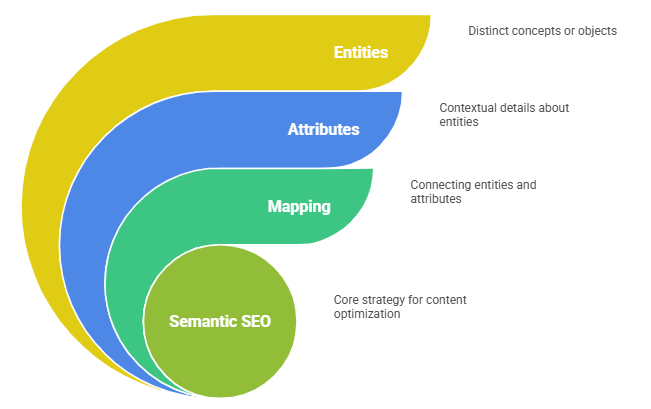
An entity is a concept that can be uniquely identified in the world of Semantic SEO. It is something that is real and can be clearly defined. An entity is like a noun that the search engine has stored in its database. Google’s Knowledge Graph keeps track of millions of these entities and how they are related to each other.
Categories of Entities We Map
- People including industry leaders and experts in your field
- Brands and organizations like Directions Solutions
- Services such as technical SEO or web development
- Broad topics like artificial intelligence or marketing
- Specific technologies and software tools
- Geographic locations where your business operates
I check to see if we have talked about the right people when I look at a piece of content. Search engines will think your content is incomplete if you write about digital marketing but never mention SEO or social media.
Practical Example Entity Digital Marketing
Let’s make Digital Marketing our main thing. At Directions Solutions, this is one of our main areas of focus. I can’t just write the phrase “digital marketing” over and over if I want to rank for it. I need to include the network of businesses that make up the industry.
The Cluster of Related Entities
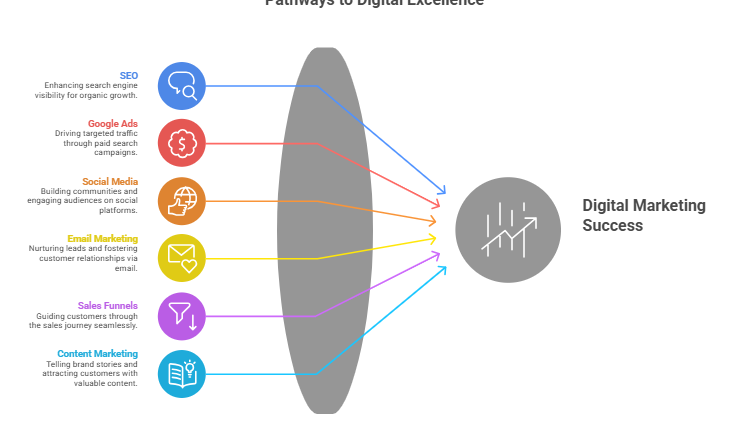
- Search Engine Optimization and organic growth
- Google Ads and the world of paid search
- Social Media Marketing and community building
- Email Marketing and lead nurturing
- Sales Funnels and the customer journey
- Content Marketing and brand storytelling
- Conversion Rate Optimization and ROI
I am telling the search engine that I am an expert by putting these related entities in one complete guide and to understand how to rank in chatgpt responses fast check out our other blog on SEO optimization in chatgpt as well. I am giving you a full map of the subject. This is how Directions Solutions stays at the top of the search results, and you should do the same.
Understanding Attributes and Their Power
Attributes are the words that describe an entity and give it its flavour. They are the traits that help a search engine tell one thing from another. If the entity is a car, for instance, the attributes could be the colour or the size of the engine. In SEO, attributes tell you what a topic does and how important it is.
Our Proprietary Mapping Table
- Digital Marketing is an online growth strategy that impacts business revenue
- SEO delivers organic traffic and is connected to Google rankings
- Google Ads provides paid traffic and is connected to instant conversions
- Content Marketing offers informative content and builds audience engagement
- Sales Funnel maps the customer journey and drives final sales
- Conversion Rate measures the percentage of visitors who buy and determines ROI
When you link an entity to its attributes, you make a lot of information that is hard to untangle. This is what Google wants to see. It wants to know that you know more than just the name of a topic; it wants to know how it works and what it makes.
How Entities and Attributes Map Together
Picture a person going to a search bar and typing “how to boost sales with digital marketing.” The search engine doesn’t just look for those words. It does a complicated mapping job.
The Search Engine Logic Flow
- First it identifies the Primary Entity which is Digital Marketing
- Next it looks for the Intent Attribute which is the desire to increase sales
- Then it pulls in Related Entities like SEO and Sales Funnels
- Finally it evaluates the Context which in this case is business growth
At Directions Solutions, we organize our content in a way that reflects this same logic. We begin with the big picture and then drill down into the entities and attributes that are related. This ensures that our content is the most logical choice for the search engine to display at the top of the search results page.
How Search Engines Use Semantic Mapping
Search engines employ a range of high-level technologies in order to accomplish this mapping. They employ Natural Language Processing in order to read and understand the subtleties of human language. They also employ the Knowledge Graph in order to check facts.
The Role of Context
Context is key. If you are writing about a jaguar, the search engine must understand whether you are referring to the animal or the car. They accomplish this by examining the surrounding entities. If you are writing about tires and engines, they understand that you are referring to the car. If you are writing about the jungle and prey, they understand that you are referring to the animal.
At Directions Solutions, we ensure that all of the content that we create has sufficient context to make it clear. We build a fortress of related concepts around our main topics so there is no confusion about our expertise.
Building Your Semantic SEO Strategy Step by Step
I want you to be able to do exactly what we do. Here is the step by step process I have developed for my team at Directions Solutions. Follow this and you will see your topical authority skyrocket.
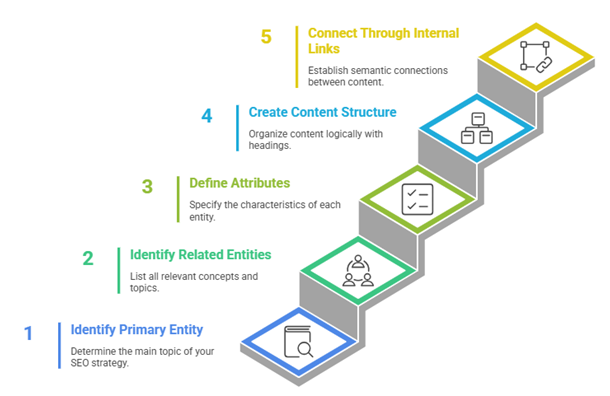
Step 1 Identify Your Primary Entity
What is the main thing you want to be known for. This is your foundation. Do not pick a keyword pick a concept.
Step 2 Identify Related Entities
Brainstorm every subtopic that is essential to your main concept. If your main entity is Health your subtopics might be Nutrition and Exercise and Sleep.
Step 3 Identify Attributes
What are the goals and measurements for these subtopics. For Nutrition the attributes might be calories or vitamins or meal planning.
Step 4 Structure Content Using Entity Hierarchy
Your H1 is your main entity. Your H2s are your sub entities. Your paragraphs are where you define the attributes and relationships. This creates a vertical and horizontal map of knowledge that search engines love.
Example of a Fully Mapped Semantic Structure
Let us look at how this looks in a real world content plan.
- Primary Entity is Digital Marketing
- Sub Entities are Content Strategy and Funnel Optimization
- Attributes are leads and revenue and growth metrics
The relationship flow is a powerful circle. Digital Marketing drives the traffic. SEO and Ads are the engines. The Funnel is the path to conversion. The Conversion Rate is the measure of success. And the result is Revenue for the business. This is the exact blueprint we use at Directions Solutions to help our clients grow.
Why Semantic SEO Improves Rankings and Why You Must Start Now
If you are still focusing on old school keyword density you are leaving money on the table. Semantic SEO is the future and the future is already here.
The Strategic Advantages
- Algorithms understand your expertise much faster
- You will rank for thousands of related long tail queries without trying
- You build a deep level of trust with both users and bots
- Your content stays relevant even as search trends change
- It aligns perfectly with how modern AI search engines operate
At Directions Solutions we have seen that sites using this strategy are more resilient to algorithm updates. When Google changes its rules it usually does so to find better meaning. If you are already providing that meaning you have nothing to fear.
Final Thoughts from Saad Asif
The digital landscape is more competitive than ever. You cannot afford to be just another voice in the crowd. You need to be the authority. By using Semantic SEO you are proving to the world that you understand your subject inside and out.
I have shared this strategy with you because I believe in the power of quality information. At Directions Solutions we pride ourselves on being at the cutting edge of these developments. I encourage you to take these lessons and apply them to your own site today. Build your entities define your attributes and map your way to the top of the search results.
Frequently Asked Questions
What is an entity in Semantic SEO
An entity is a distinct and identifiable concept such as a person or a brand. At Directions Solutions we treat entities as the core building blocks of any successful SEO strategy.
What are attributes in Semantic SEO
Attributes are the specific details that describe an entity. They help search engines understand the context and the value of the information you are providing on your page.
How does Semantic SEO differ from traditional SEO
Traditional SEO is about matching words. Semantic SEO is about matching meaning. It is a more sophisticated way of building authority that focuses on topics instead of strings of text.
Do I still need keywords in Semantic SEO
Yes you do. Keywords are still the way users express their intent. However we use them as part of a larger entity map rather than just stuffing them into the text.
How can I apply Semantic SEO to my website
Start by identifying your core entity and mapping out the related subtopics. Create long form content that covers the entire subject in depth. If you need help with this my team at Directions Solutions is always here to guide you toward ranking higher and growing your brand.