

Finding the Best AI Tools for SEO in 2026 can make SEO faster, smarter, and easier to manage. I’m Saad Asif, the CEO of Directions Solutions, and in my experience of more than a decade, from finding valuable keywords to improving content and identifying technical problems, AI is changing how marketers approach search optimization.
This guide compares 15 AI SEO tools and explains what each one does best, who should use it, and how it can support your SEO strategy.
Why AI Is Changing SEO in 2026
Artificial intelligence is transforming traditional SEO workflows by moving optimization from reactive fixes to predictive, real-time strategies. Marketers no longer spend endless hours manually pulling keyword spreadsheets or auditing code line by line.
- Data Analysis at Scale: AI processes vast search trends, user intent signals, and rank fluctuations continuously.
- Workflow Automation: Repetitive tasks like content gap discovery, internal link building, and meta tag generation are fully automated.
- Predictive Insights: Modern platforms forecast keyword trajectory and intent shifts before content is written.

However, AI does not eliminate the need for human SEO expertise. It acts as an accelerator, giving strategists actionable intelligence so they can make faster and more informed decisions.
15 Best AI Tools for SEO in 2026
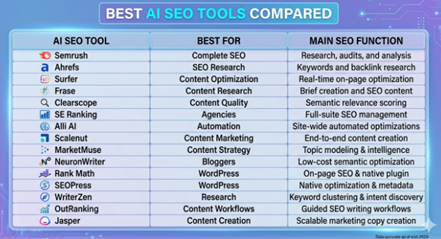
1. Semrush offers an all-in-one suite with predictive keyword metrics, automated site audits, AI writing assistants, and brand tracking across search engines and AI engines.
- Best for: Complete SEO management
2. Ahrefs: Industry standard for deep backlink analysis, domain authority tracking, keyword research, and AI-driven content gap detection.
- Best for: SEO research and backlink analysis
3. Surfer analyzes top-ranking search engine result pages (SERPs) in real time to generate live content scores, structural guidelines, and natural NLP keyword targets.
- Best for: SEO content optimization
4. Frase combines search intent analysis, AI content brief creation, and automated outline generation directly from SERP data.
- Best for: SEO-focused content creation
5. Clearscope focuses on content quality by scoring semantic relevance and topical coverage to ensure long-form pages thoroughly address user query intent.
- Best for: Content teams focused on quality
6. SE Ranking Delivers rank tracking, automated website audits, competitor insights, and AI-driven content marketing tools tailored for growth.
- Best for: Businesses and agencies
7. Alli AI Automates site-wide technical and on-page SEO changes directly on your website via a lightweight code snippet.
- Best for: Website owners seeking automation
8. Scalenut provides an end-to-end content workflow, from keyword clustering and AI outline creation to content writing and optimization.
- Best for: Content marketing teams
9. MarketMuse uses deep topic modeling and content intelligence to evaluate entire domain topical authority and highlight structural content gaps.
- Best for: Large content websites
10. NeuronWriter offers semantic content recommendations based on competitor SERP analysis, utilizing NLP models to optimize articles affordably.
- Best for: Bloggers and content marketers
11. Rank Math Integrates AI features directly into WordPress to optimize post titles, schema markup, dynamic meta tags, and internal link suggestions.
- Best for: WordPress users
12. SEOPress: A lightweight WordPress SEO suite that leverages AI for mass meta description generation, image alt-tag automation, and on-page optimization.
- Best for: WordPress website optimization
13. WriterZen Simplifies early-stage SEO research by organizing broad keywords into structured topic clusters and intent-focused content maps.
- Best for: Keyword and content research
14. OutRanking builds guided, data-driven content workflows using AI to help teams draft and optimize rank-ready articles step-by-step.
- Best for: Structured SEO content workflows
15. Jasper generates scalable copy across formats, working alongside specialized SEO tools to accelerate initial draft creation.
- Best for: AI-assisted content production
What Should You Look for in the Best AI Tools for SEO in 2026?
Before selecting an AI SEO platform, evaluate these primary core capabilities against your team’s operational goals:
- Keyword Research Features: Look for automated intent classification, semantic clustering, predictive search volume, and real-time gap analysis.
- Content Optimization: Prioritize real-time topic scoring, competitor NLP breakdown, natural keyword integration, and readability metrics.
- Technical SEO Capabilities: Ensure the tool delivers dynamic crawling, automated site audits, Core Web Vitals diagnostics, and schema recommendations.
- Competitor Analysis: Evaluate how effectively the tool decodes competitor content strategies, backlink origins, and ranking shifts.
- Ease of Use and Pricing: Consider interface clarity, API access, project limits, and pricing structures based on your business size and seats needed.
Best AI Tools for SEO Based on Your Goals
- Best AI SEO Tool for Keyword Research: Semrush and Ahrefs lead the industry by combining deep search databases with AI-powered intent grouping and competitor gap detection.
- Best AI SEO Tool for Content Optimization: Surfer and Clearscope excel at analyzing live SERPs to give real-time word count, structure, and keyword density targets.
- Best AI SEO Tool for Technical SEO: Alli AI and Semrush streamline complex site health monitoring, script fixes, and crawl-budget optimization.
- Best AI SEO Tool for Beginners: Rank Math and NeuronWriter offer clear interfaces, guided setups, and affordable pricing for those building basic SEO workflows.
- Best AI SEO Tool for Agencies: SE Ranking and Semrush feature comprehensive multi-domain reporting, client permission management, and white-label capabilities.
- Best AI SEO Tool for Small Businesses: WriterZen and Scalenut offer cost-effective, targeted feature sets focused on content creation and local keyword growth.
AI SEO Tools vs Traditional SEO Tools
- Faster Data Analysis: Traditional tools require manual filtering of raw numbers. AI platforms interpret search trends instantaneously, reducing manual analysis time.
- More Automation: AI tools execute repetitive tasks like draft outline generation, tag creation, and broken link audits without manual intervention.
- Smarter Recommendations: Rather than listing isolated metrics, modern platforms offer contextual action plans based on real-time competitor movements.
- Human Strategy Still Matters: AI outputs are only as strong as your brand direction. Evaluating recommendations against audience nuances and business goals remains essential.
Common Mistakes When Using AI SEO Tools
- Publishing Low-Quality AI Content: Raw, unedited AI content often lacks unique value, leading to poor user engagement and algorithmic downgrades.
- Ignoring Search Intent: Matching keywords without matching user expectations (informational vs. transactional intent) leads to high bounce rates.
- Following Every AI Recommendation: Treat tool scores as helpful directions, not absolute rules. Over-optimizing content ruins readability.
- Focusing Only on Rankings: Keyword positions mean little if traffic fails to convert into active leads or revenue.
Are the Best AI Tools for SEO in 2026 Worth It?
Investing in the Best AI Tools for SEO in 2026 is generally worth it for businesses looking to scale search visibility efficiently. The software pays for itself by reducing labor hours and surfacing high-converting opportunities quickly.
However, buying expensive tools does not guarantee instant top rankings. Success depends on team execution, quality landing page design, strong authority signals, and maintaining clear strategic goals.
How to Choose the Right AI SEO Tool
- For Beginners: Opt for straightforward, intuitive platforms like Rank Math or NeuronWriter that provide clear task lists.
- For SEO Professionals: Invest in full-scale platforms like Semrush or Ahrefs for comprehensive research and technical depth.
- For Content Teams: Select SERP-driven optimization engines like Surfer or Clearscope to streamline editor workflows.
- For Agencies: Prioritize platforms like SE Ranking that support robust multi-client reporting and site tracking capabilities.
Final Verdict: Which AI SEO Tool Should You Choose?
There is no single platform that satisfies every single marketing team. The Best AI Tools for SEO in 2026 depend entirely on your budget, team experience, target audience, and scale.
For comprehensive domain management, all-in-one suites like Semrush lead the industry. For dedicated writers, specialized platforms like Surfer deliver unmatched on-page guidance. The strongest approach pairs algorithmic tools with human strategic direction to build sustainable organic growth.
Frequently Asked Questions
What are the Best AI Tools for SEO in 2026? The Best AI Tools for SEO in 2026 include platforms like Semrush, Ahrefs, Surfer, and Clearscope. The best choice depends on whether your priority is keyword discovery, technical site auditing, or on-page content optimization.
Can AI SEO tools improve Google rankings? AI SEO tools identify high-value keyword targets, content gaps, and structural issues to help optimize your site. However, rankings depend on content quality, backlink authority, user experience, and algorithm shifts.
Are AI SEO tools suitable for beginners? Yes, many tools feature clean dashboards and automated recommendations that guide beginners through basic optimization without requiring extensive technical experience.
Can AI replace SEO professionals? No, AI automates data processing and routine tasks, but human marketers are still required to direct positioning, evaluate search intent, curate creative direction, and make business decisions.
What is the best AI SEO tool for content optimization? Surfer, Frase, and Clearscope are widely recognized as top options for content optimization due to their SERP analysis and real-time semantic scoring capabilities.