
Choosing between AI Google Ads and manual PPC can directly affect how efficiently your advertising budget is spent. I’m Saad Asif, the CEO of Directions Solutions, and in my experience of more than a decade, Artificial intelligence can automate bidding, targeting, and ongoing optimizations in real-time. On the other hand, manual PPC gives search marketers granular control over every keyword, bid adjustment, and message placement.
This comprehensive guide compares both approaches across crucial performance areas including bidding precision, audience targeting, ad creative optimization, cost controls, and campaign scalability, so your business can make a data-backed advertising decision.
AI Google Ads vs Manual PPC: 7 Key ROI Differences
Evaluating AI Google Ads vs Manual PPC requires looking past superficial metrics to examine how each system manages variables that drive ROI.
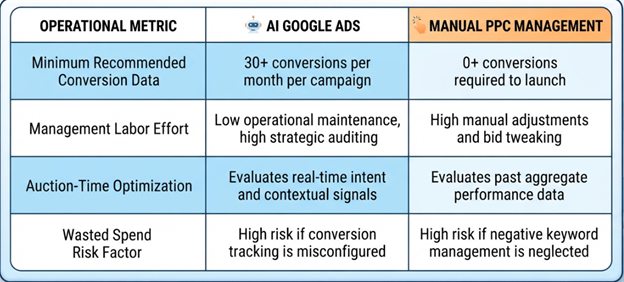
1. Bidding and Budget Optimization: AI bidding operates at auction time, continuously modifying bids for every individual search query based on contextual signals. Manual PPC relies on static bid caps or periodic bulk changes. While AI offers rapid responsiveness, manual PPC ensures that bid decisions adhere strictly to fixed financial caps without unexpected fluctuations.
2. Audience Targeting: AI algorithms discover hidden audience relationships by analyzing cross-network user behaviors, often capturing high-converting users outside target keyword lists. Manual PPC restricts reach strictly to defined keywords and targeted lists. AI excels at finding volume, whereas manual PPC ensures strict alignment with specific target parameters.
3. Ad Creative Optimization: Using Responsive Search Ads (RSAs) and dynamic asset combinations, AI tests dozens of headlines and descriptions simultaneously to deliver the highest CTR for specific user profiles. Manual PPC requires marketers to write fixed ad units and evaluate performance manually. While AI speeds up dynamic testing, human oversight ensures that ad copy remains on-brand and clear.
4. Campaign Optimization Speed: Machine learning models analyze performance data 24 hours a day, executing optimizations instantly as search trends shift. Manual PPC optimization speed is limited by how frequently an analyst reviews account reports. When scaling spend across competitive verticals, AI’s operational speed provides a key advantage.
5. Cost Control: Manual PPC provides predictable spending boundaries by letting managers set absolute CPC caps and daily campaign budgets. AI algorithms prioritize conversion volume or target returns, which can temporarily spike cost-per-click during high-competition auctions. Without clear target constraints, automated campaigns can consume budgets rapidly.
6. Scalability: Scaling manual PPC campaigns requires significant labor—building out keyword matrices, writing specialized copy, and monitoring daily bids. AI-driven campaign structures, such as Performance Max, scale smoothly across multiple placements (Search, Maps, Display, YouTube, Discover) with minimal extra operational overhead.
7. Overall ROI Potential: Neither approach guarantees high ROI on its own. AI amplifies efficiency when provided with high-quality conversion tracking, clear revenue goals, and distinct creative inputs. Manual PPC protects ROI in accounts with low conversion data, highly volatile markets, or low monthly budgets. Ultimately, long-term ROI relies on aligning campaign structure with business objectives.
AI Google Ads vs Manual PPC: Which Is More Cost-Effective?
Determining cost-effectiveness requires factoring in both direct ad spend and management overhead.
When Manual PPC Can Deliver Better ROI
- You operate with a limited daily ad budget where every dollar counts.
- You are launching a new product line or business without historical conversion data.
- You sell hyper-niche B2B services with low total search volume and high average deal values.
- Your business requires absolute control over exact search term triggers and published ad copy.
Can AI and Manual PPC Work Together? (The Hybrid Model)
Choosing between AI Google Ads vs Manual PPC does not have to be an all-or-nothing decision. Modern PPC management often yields the best results using a Hybrid PPC Strategy.
By combining machine learning efficiency with human strategy, businesses can automate routine calculations while keeping people in charge of broad strategy, messaging, and account safety.
What AI Should Handle
- Auction-time CPC adjustments based on conversion signals.
- Real-time budget allocation between top-performing asset groups.
- Dynamic multi-asset combination testing (Responsive Search Ads).
- Pattern detection across broad-match search query intent.
What Humans Should Handle
- Value proposition development and high-converting ad copy.
- Strategic business goal setting and Target CPA/ROAS adjustments.
- Account hygiene: negative keyword audits and conversion tracking verification.
- Landing page conversion rate optimization (CRO) and offer alignment.
How to Choose Between AI Google Ads and Manual PPC
Use this decision matrix to align your advertising approach with your operational capability:
- Choose AI Google Ads if: You have established conversion tracking, sufficient monthly ad spend, and need fast, scalable campaign execution.
- Choose Manual PPC if: You require strict keyword management, operate in heavily regulated markets, or have limited initial data.
- Choose a Hybrid Approach if: You want to capture the speed and optimization of Smart Bidding while maintaining human oversight over keyword exclusions, budget distribution, and creative direction.
5 Mistakes to Avoid When Using AI Google Ads
- Trusting Automation Without Oversight: Treating AI as a set-and-forget solution leads to query drift. Automated broad match can target irrelevant search terms without active negative keyword lists.
- Using Poor Conversion Tracking: Machine learning optimizes toward the data it receives. If you track low-value actions (like page visits) instead of revenue or qualified leads, AI will bring in low-value traffic.
- Ignoring Ad Creative Quality: AI optimizes asset combinations, but it cannot fix weak messaging or poor value propositions. Strong ad copy remains essential.
- Changing Campaigns Too Frequently: Frequent updates to target ROAS, CPA, or budget settings reset the machine learning model, keeping campaigns in an unstable “Learning Phase.”
- Measuring Clicks Instead of Business Results: Evaluating performance based on clicks or CTR rather than Cost Per Acquisition, lead quality, and customer lifetime value (LTV) masks true campaign ROI.
How to Improve ROI With AI Google Ads
- Set Clear Conversion Goals: Configure primary conversion actions so algorithms optimize toward core revenue events rather than superficial metrics.
- Feed High-Quality Data to Algorithms: Pass first-party CRM data via Offline Conversion Tracking (OCT) or Enhanced Conversions to teach AI which leads turn into paying customers.
- Provide Diverse Creative Assets: Give Responsive Search Ads a wide selection of headlines, descriptions, images, and site links to build optimal ad combinations.
- Perform Regular Search Term Audits: Review search query reports weekly to add irrelevant queries to your negative keyword list.
- Combine Automation With Human Strategy: Use machine learning for data processing and manual oversight for strategic direction, brand positioning, and budget management.
AI Google Ads vs Manual PPC: Final Verdict
Neither approach is universally superior. The ideal choice between AI Google Ads vs Manual PPC depends on campaign volume, account history, available budget, and operational capacity.
For brand-new campaigns, small budgets, or niche B2B markets, manual PPC provides the control required to protect ad spend. For established accounts with rich historical data, AI automation offers unparalleled speed and efficiency. Ultimately, most successful campaigns leverage a hybrid model—combining algorithmic execution with human strategic direction to drive maximum ROI.
Frequently Asked Questions
- Is AI Google Ads better than manual PPC?
AI Google Ads is generally more efficient for data-rich accounts that require automated bidding, dynamic creative testing, and multi-channel scaling. However, manual PPC remains valuable for accounts lacking conversion history, operating on limited budgets, or requiring absolute keyword precision.
- Does AI Google Ads reduce advertising costs?
AI can improve ad efficiency by optimizing bid distribution toward high-converting auctions, but it does not guarantee lower CPCs or total costs. Campaign cost-effectiveness depends heavily on landing page quality, clear bidding parameters, and accurate conversion tracking.
- Is manual PPC still effective?
Yes, manual PPC is effective for small budgets, niche B2B sectors, new product launches, and highly regulated industries. It allows media buyers to set strict bid boundaries and control ad copy without relying on machine learning assumptions.
- Can businesses use AI and manual PPC together?
Yes. A hybrid PPC strategy allows automated algorithms to handle auction-time bidding and asset combinations, while human managers supervise negative keyword management, conversion validation, landing page optimization, and high-level marketing strategy.
- How can I improve Google Ads ROI?
To improve overall ROI, ensure conversion tracking is set up accurately, optimize landing page conversion rates, regularly audit search terms for negative keyword opportunities, and use automated bidding strategies only after building sufficient baseline conversion data.