


Google Ads is becoming increasingly automated, and artificial intelligence is changing how businesses create, target, and optimize advertising campaigns. I’m Saad Asif, the CEO of Directions Solutions, and in my experience of more than a decade, for Dubai businesses, understanding how AI Is Changing Google Ads can help marketers make smarter decisions, improve efficiency, and compete in a crowded digital market.
From smart bidding to automated targeting and creative optimization, AI is transforming almost every stage of paid search advertising.
7 Major Ways AI Is Changing Google Ads
1. Smart Bidding Is Becoming More Intelligent
Machine learning algorithms evaluate over 70 real-time auction signals—including device, geographical micro-location, time of day, language, and browsing history—in milliseconds.
Automated bidding strategies adapt to distinct commercial goals:
- Maximize Conversions: Drives overall volume within your daily budget.
- Target CPA (Cost Per Acquisition): Maintains customer acquisition within set target costs.
- Target ROAS (Return on Ad Spend): Prioritizes high-value orders to optimize profit margins.
Smart Bidding requires high-quality conversion data to train its models accurately. Local advertisers must ensure accurate conversion tracking and offline CRM integration before handing bid control entirely to algorithms.
2. AI Is Transforming Audience Targeting
Traditional targeting relied heavily on manual age, gender, and broad keyword matching. Generative engine models analyze search behavior, contextual intent, historical purchase paths, and conversion patterns to build dynamic audience profiles.
This shift ensures your ad budget focuses on users actively exhibiting buying intent rather than burning impressions on casual browsers.
3. AI Is Automating Ad Creative
Generative AI tools and Responsive Search Ads (RSAs) automatically mix and match headlines, descriptions, images, and video assets to serve the highest-performing combination for each user query.
Key operational advantages include:
- Accelerating creative asset production and testing cycles.
- Testing dozens of unique headline variations simultaneously.
- Scaling personalized messaging across diverse consumer segments.
Advertisers must supply strong, on-brand asset libraries so the algorithm has quality inputs to assemble.
4. AI Is Improving Search Intent Matching
Conversational queries and natural language search patterns mean users rarely type rigid keyword phrases. Machine learning models interpret the underlying user intent behind complex, multi-word searches.
To maximize performance, Dubai brands must align landing page content with real user intent, ensuring seamless journeys from initial search query to final conversion.
5. AI Is Changing Performance Max Campaigns
Performance Max (PMax) represents Google’s core cross-channel automated campaign format, consolidating inventory across Search, Shopping, YouTube, Display, Discover, Gmail, and Maps into a unified system.
What Advertisers Gain
- Automated budget allocation across all Google advertising channels.
- Massive audience reach across broad user touchpoints.
- Continuous real-time optimization toward target conversion actions.
What Advertisers Still Need to Control
- Setting precise conversion values and campaign targets.
- Providing high-resolution image and video creative assets.
- Applying negative keywords and audience exclusion parameters.
- Maintaining conversion-focused landing page experiences.
6. AI Is Improving Lead Generation
Machine learning algorithms analyze downstream user activities to separate casual clicks from qualified sales inquiries.
Practical application across Dubai business models:
- Real Estate: Identifying buyers looking for luxury villas vs. short-term rentals.
- Education: Filtering high-intent applicant profiles for executive degree programs.
- Hospitality: Prioritizing direct venue booking inquiries over general traffic.
- Professional Services: Targeting business owners seeking corporate setup services.
Focusing on lead quality over raw lead volume maximizes overall sales team productivity and ad profitability.
7. AI Is Making Campaign Optimization Faster
Manual account auditing often takes days or weeks to uncover poor-performing placements or audience segments. Algorithmic systems process account performance metrics continuously, highlighting shifts in customer behavior and creative fatigue almost instantly.
Marketers can use these rapid insights to make strategic adjustments rather than wasting hours compiling spreadsheet reports.
Traditional Google Ads vs AI-Powered Google Ads
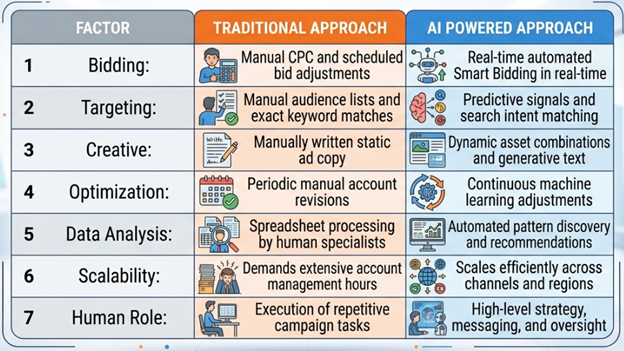
Artificial intelligence does not remove human marketers; it elevates their role from execution to strategy and positioning.
Benefits of AI Is Changing Google Ads for Dubai Businesses
Better Advertising Efficiency
Automating repetitive bidding and placement adjustments lets marketing teams dedicate more energy to offer creation, brand messaging, and strategic business growth.
Faster Optimization
Machine learning handles data aggregation instantly, identifying converting ad combinations and adjusting auction bids far faster than humanly possible.
Improved Personalization
Delivering dynamically tailored headlines and media based on user signals creates personal ad experiences that drive higher click-through rates.
Easier Campaign Scaling
Businesses launching campaigns across regional markets or managing large e-commerce catalogs can scale ad spend smoothly without multiplying campaign management labor.
Better Use of Marketing Data
Integrating first-party CRM data into automated campaigns helps algorithms identify high-value customer lookalikes across all Google networks.
The Challenges of Using AI in Google Ads
Less Manual Control
High levels of automation reduce granular control over individual keyword bids and placement choices.
Poor Data Can Lead to Poor Decisions
Automated systems rely entirely on incoming signals. Broken tag tracking or misconfigured conversion events cause algorithms to optimize toward low-value traffic.
AI Does Not Understand Every Business Goal
Algorithms optimize strictly for the numbers you define; they do not natively understand product margins, operational capacities, or brand nuance.
Creative Quality Still Matters
Machines assemble creative pieces, but compelling value propositions, unique positioning, and persuasive messaging require human strategic oversight.
Automation Does Not Guarantee Profit
Generating high conversion volumes does not automatically lead to net profit if campaign acquisition costs exceed product margins.
How Dubai Businesses Can Use AI Effectively in Google Ads
Step 1: Define Clear Campaign Goals
Establish exact conversion values, target CPA boundaries, or required ROAS figures before launching automated strategies.
Step 2: Fix Conversion Tracking
Implement Google Tag Gateway and Enhanced Conversions to send accurate, privacy-compliant conversion data back to campaign models.
Step 3: Provide High-Quality Creative Assets
Supply asset groups with diverse headlines, short-form video content, high-resolution lifestyle images, and compelling value propositions.
Step 4: Create Relevant Landing Pages
Ensure landing page copy, layout speed, and offer details closely reflect the promises made in your ad creatives.
Step 5: Monitor Lead Quality
Regularly check lead quality metrics inside your CRM to verify that automated campaigns generate paying customers rather than low-value inquiries.
Step 6: Combine AI With Human Expertise
Use machine automation for data processing and real-time bidding, while human strategists manage offer positioning, market research, and overall budget allocation.
Common AI Google Ads Mistakes to Avoid
Giving AI an Unclear Goal
Launching Smart Bidding without defining specific primary conversions causes campaigns to waste budget chasing low-value page views.
Relying on Automation Without Monitoring
Treating campaigns as a set-and-forget setup leads to missed performance drops, creative fatigue, or improper placements.
Ignoring Negative Business Outcomes
Failing to evaluate actual sales numbers allows campaigns to report high conversion volumes while delivering poor commercial returns.
Using Generic AI-Generated Ad Copy
Publishing generic, unedited ad copy strips away brand personality and fails to resonate with competitive local audiences.
Forgetting the Customer Experience
High-performing ads cannot rescue broken landing page layouts, slow loading speeds, or confusing checkout procedures.
Is AI Better Than Manual Google Ads Management?
Machine learning algorithms excel at processing vast quantities of data, evaluating real-time user signals, and calculating instant auction bids across channels. However, automated platforms cannot replicate human understanding of local customer psychology, competitive dynamics, brand positioning, and pricing strategy.
The best marketing setup connects rapid algorithmic data processing with human commercial judgment.
The Future of AI Is Changing Google Ads
- Increased Campaign Automation: Account management will shift further toward high-level goal definition and asset generation.
- Expanded Generative Creative: Asset creation tools will construct custom video and image variations on the fly.
- Priority on First-Party Data: First-party data integration will become the primary differentiator for training machine learning models.
- Focus on Commercial Outcomes: Optimization will pivot heavily toward net profit, lifetime customer value, and verified offline conversions.
- Strategic Human Leadership: Expert marketers will remain essential for brand narrative, commercial strategy, and user experience design.
Final Verdict: How AI Is Changing Google Ads
Understanding how AI Is Changing Google Ads shows that automation is redefining how digital campaigns are built, targeted, and optimized. For Dubai companies operating in aggressive digital channels, automation offers significant advantages in speed, scale, and performance tracking. Combining machine efficiency with experienced human strategy ensures your advertising budget yields sustainable commercial growth.
Frequently Asked Questions
How is AI changing Google Ads in 2026?
AI transforms paid search marketing by automating real-time bidding, refining audience targeting, generating ad creatives, and streamlining cross-channel campaigns like Performance Max. Algorithms continuously analyze real-time context signals during every search auction to optimize results toward specified goals. Advertisers focus on high-level strategy, creative assets, and first-party data management.
Is AI better than manual Google Ads management?
Automated tools process data and calculate real-time auction bids far more efficiently than human account managers. However, algorithms lack human intuition regarding brand identity, local customer psychology, commercial margins, and overall strategy. A hybrid approach combining automated bidding with strategic human oversight produces the best results.
Can AI improve Google Ads performance?
Machine learning algorithms improve performance by optimizing bids toward defined conversion goals and processing vast data sets in real time. However, overall success still depends on external factors like campaign tracking accuracy, landing page quality, budget allocation, and compelling creative messaging. Automation requires clean data to deliver strong results.
Should Dubai businesses use AI-powered Google Ads?
Yes, Dubai businesses operating in competitive industries like real estate, tourism, e-commerce, and professional services benefit significantly from automated Google Ads strategies. Algorithmic targeting and Smart Bidding help brands reach intent-driven customers efficiently. Companies should ensure accurate conversion tracking before scaling automated budgets.
Will AI replace Google Ads professionals?
Artificial intelligence is shifting the role of Google Ads professionals rather than replacing them completely. Instead of spending hours making manual keyword bid adjustments, specialists now focus on strategic positioning, creative direction, conversion tracking setup, and profitability analysis. Marketers who guide AI tools strategically remain vital to campaign success.