


Search is changing faster than ever. People are no longer relying only on traditional search engines to find information, products, and businesses. I’m Saad Asif, the CEO of Directions Solutions, and in my experience of more than a decade, the debate around GEO vs SEO is becoming increasingly important as AI-powered search platforms provide direct answers instead of simply displaying a list of websites.
This guide explains the key differences and shows how companies can prepare for the future of search.
What Is GEO?
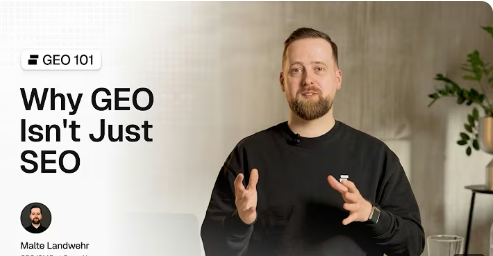
Generative Engine Optimization focuses on improving the likelihood that a brand’s information is understood, surfaced, or referenced within AI-generated search experiences like ChatGPT, Perplexity, and Gemini.
How GEO Works
AI engines pull from multiple web sources to synthesize answers. GEO relies on specific foundational pillars:
- Clear, factual, and concise content
- Strong entity recognition and context
- Reliable third-party citations and brand mentions
- Demonstrable original expertise
- Structured schema markup
- Consistent online business information
Businesses cannot guarantee an AI platform will cite them, but structured context increases citation probability.
What Is SEO?
Traditional Search Engine Optimization focuses on improving a website so search engines like Google and Bing can understand, rank, and display its pages for relevant searches.
How Traditional SEO Works
Conventional search engine optimization relies on proven digital strategies:
- Keyword research to target search demand
- On-page optimization including title tags and headings
- Technical SEO for fast crawling and site indexation
- Human-centered content creation
- Internal linking architectures
- Link building from high-authority websites
- Local map pack optimization
What Is the Main Goal of SEO?
The primary objective of traditional SEO is to help relevant users discover web pages through search engine results pages and drive organic website traffic.
Conversational and AI-assisted search allows customers to ask detailed questions and receive synthesized answers rather than browsing multiple search links. Brands cited within those summaries gain instant recommendations.
GEO vs SEO: What Is the Difference?
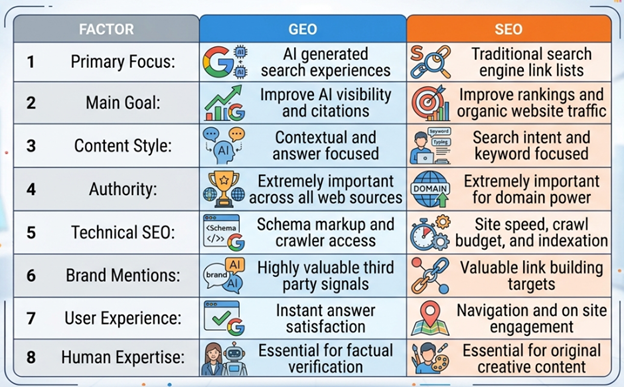
There is significant overlap between both approaches. The best digital marketing strategy uses them together rather than treating them as competing systems.
7 Key Differences Between GEO vs SEO
1. Search Rankings vs AI Visibility
Traditional search strategies primarily focus on securing top numerical rankings on search result pages. In contrast, generative optimization focuses on whether AI platforms parse your content and include your brand inside synthesized summaries. Winning position one on Google no longer guarantees visibility inside an AI answer.
2. Keywords vs Context
SEO places heavy emphasis on targeted keyword insertion across title tags and body text. Generative engines look beyond simple search terms, requiring rich context around entities, topics, and relationships. Simply repeating search phrases is not enough for modern AI search visibility.
3. Website Traffic vs Customer Discovery
SEO measures success by driving direct clicks and visitors to a website. AI platforms answer user questions directly within the chat interface, leading to zero-click searches. Customer discovery occurs inside the conversational window, building brand trust even before a user clicks a link.
4. Backlinks vs Broader Authority Signals
Backlinks from authoritative domains remain a central foundation for traditional ranking algorithms. Generative search engines evaluate wider web consensus, evaluating brand mentions, directory profiles, customer reviews, and industry publications, to verify credibility.
5. Traditional Queries vs Conversational Questions
Traditional search queries often consist of short phrases like best CRM software. AI search interactions are conversational, with users typing complex, multi-part prompts. Content must be structured to directly answer comprehensive user questions.
6. Ranking Pages vs Being Referenced
Evaluating search engine performance relies on click-through rates, search rankings, and organic impressions. Measuring generative visibility relies on new metrics like AI citations, source references, and total brand inclusion across generated answers.
7. Search Optimization vs Search Experience Optimization
SEO helps optimize digital pages for crawlers and human readers. Generative optimization elevates the entire search experience, ensuring complex information is parsed, summarized, and presented accurately in conversational formats.
Why Businesses Should Combine GEO and SEO
Analyzing GEO vs SEO reveals that businesses should not choose one over the other. The most effective playbook combines strong technical foundations with generative content design.
SEO Builds Search Visibility
Traditional optimization establishes site architecture, indexes web pages, builds backlink domain authority, and secures consistent organic traffic.
GEO Expands AI Search Visibility
Generative optimization formats expert knowledge so large language models can extract, cite, and recommend your brand within instant answers.
Together They Create Broader Search Coverage
Combining both strategies creates a complete visibility net across both traditional Google search lists and emerging AI platforms.
How to Build a GEO and SEO Strategy
Step 1: Build a Strong SEO Foundation
Ensure your website features clean site architecture, strong technical speed, canonical tags, clear navigation, and mobile usability.
Step 2: Answer Important Customer Questions
Structure content using direct question headings and concise answer blocks that generative platforms can lift effortlessly.
Step 3: Demonstrate Genuine Expertise
Inject real-world case studies, author credentials, statistical data, and direct industry insights into every piece of content.
Step 4: Strengthen Brand Authority
Expand your online footprint by securing brand mentions across industry publications, review portals, and news outlets.
Step 5: Keep Information Consistent
Maintain accurate business names, phone numbers, addresses, and service details across your domain and external business directories.
Step 6: Monitor Both Search and AI Visibility
Track traditional rankings in webmaster tools while manually monitoring brand citations inside platforms like ChatGPT, Perplexity, and Gemini.
Common Mistakes Businesses Make With GEO vs SEO
Treating GEO as a Replacement for SEO
Abandoning traditional optimization breaks your core web indexing and domain authority. Generative engines rely on classic search indexes to discover content.
Creating Content Only for Algorithms
Writing unnatural text solely to influence machines alienates human readers. Content must prioritize clarity, accuracy, and user value.
Publishing Generic AI-Generated Content
Unedited mass-generated AI text lacks original insights, verified facts, and brand personality, leading to poor visibility across search engines.
Ignoring Brand Authority
Focusing exclusively on web page text while neglecting public reviews, PR mentions, and industry authority harms generative citation rates.
Expecting Immediate Results
Building sustainable search engine rankings and winning consistent AI citations requires long term optimization and persistent content updates.
GEO vs SEO: Which Strategy Should Businesses Choose?
Choose SEO When Your Priority Is
- Direct website traffic and page views
- Dominating traditional search engine rankings
- Local map pack visibility for physical locations
- Measurable click-through performance tracking
Focus on GEO When Your Priority Is
- AI search citations and conversational recommendations
- Building early brand discovery in zero-click environments
- Capturing complex, conversational user queries
- Becoming a recognized authority source across generative engines
The Best Strategy Is Both
Businesses should maintain traditional SEO as the essential baseline while building generative optimization techniques on top of it.
The Future of GEO vs SEO
- User behavior continues to shift toward detailed conversational prompts requiring multi-layered answers.
- Consistently accurate online information and strong third-party trust signals will determine which brands AI engines recommend.
- Digital marketing tracking will blend traditional organic traffic analytics with generative citation shares and brand mention tracking.
- Original research, lived experience, and strategic brand positioning remain essential differentiators that algorithms cannot replicate.
Final Verdict on GEO vs SEO
Evaluating GEO vs SEO reveals two complementary disciplines rather than competing approaches. Traditional SEO establishes the technical foundation, search indexing, and web traffic pipeline. Generative engine optimization builds upon that foundation, ensuring your brand stays visible, cited, and recommended inside modern AI search experiences.
Frequently Asked Questions
What is the difference between GEO and SEO?
The main difference lies in target platforms and output delivery. SEO focuses on optimizing web pages to rank in traditional search engine results and drive direct website clicks. GEO vs SEO strategies diverge because GEO targets AI assistants like ChatGPT and Gemini, optimizing content so machine learning models summarize and cite the brand within direct answers.
Is GEO replacing SEO?
No, GEO is not replacing traditional search optimization. Generative AI search models still rely on classic search engine indexes and foundational web crawling to discover, parse, and verify source information. Traditional search optimization serves as the mandatory technical foundation, while generative engine strategies build additional brand visibility on top of it.
Which is better, GEO or SEO?
Neither approach is inherently better, as both serve distinct user search journeys. Traditional search optimization remains superior for capturing users looking to click through to web pages, browse products, or read long-form content. Generative optimization is superior for earning direct recommendations inside conversational AI search answers.
How can businesses optimize for GEO?
Businesses can optimize for generative engines by writing clear, direct answers to common user questions, using schema markup, and adding structured key takeaways. Additionally, maintaining factual consistency, publishing original data, and securing authentic brand mentions across authoritative third-party websites significantly increases AI citation rates.
Will GEO become more important in the future?
Yes, generative optimization will grow increasingly vital as consumer search behavior continues shifting toward conversational AI assistants and synthesized zero-click answers. However, traditional search optimization will remain critical for domain technical health, direct site traffic, and primary web indexation for years to come.