

Digital marketing services are changing quickly as businesses adopt artificial intelligence to reach customers faster and more efficiently. Understanding AI vs Traditional Digital Marketing can help businesses choose the right approach for their goals.
I’m Saad Asif, the CEO of Directions Solutions, and in my experience of more than a decade, AI can automate tasks, analyze large amounts of data, and personalize campaigns, while traditional digital marketing continues to rely heavily on human strategy and manual processes. The answer depends on your budget, audience, goals, and marketing strategy.
This guide compares both approaches to help you make a smarter decision.
7 Key Differences Between AI Marketing and Traditional Digital Marketing
1. Automation and Manual Work
AI automates high-frequency, repetitive tasks such as campaign adjustments, drip email sequences, dynamic lead scoring, and routine reporting. Traditional digital marketing demands ongoing manual management for campaign setups, list segmentation, and report creation. Automation eliminates execution bottlenecks, allowing teams to focus on strategy.
2. Speed of Marketing Decisions
AI systems analyze real-time user activity and instantly pivot bidding strategies or content delivery. Traditional marketing relies on retrospective analysis—weekly or monthly reviews—where team members gather data, discuss patterns, and manually implement campaign tweaks.
3. Personalization
AI achieves hyper-personalization at scale by serving individual web visitors custom product recommendations, tailored ad variations, and tailored content based on real-time behavior. Traditional personalization is broader, typically grouping audiences into static personas or demographic segments.
4. Cost and Resource Requirements
AI requires upfront investments in software licenses, platform integration, and specialized tools, but drastically cuts ongoing manual labor overhead. Traditional digital marketing scales costs linearly with team headcount and manual management hours.
5. Data Analysis and Insights
While human analysts can easily miss subtle trends in complex datasets, AI rapidly evaluates thousands of variables to uncover hidden conversion paths and predictive churn metrics. Traditional data analysis remains effective but is limited by the time required to slice and interpret raw analytics.
6. Creativity and Human Connection
Traditional marketing leads in high-concept brand storytelling, subtle humor, emotional connection, and original voice. AI can generate variations and assist with ideation, but it lacks genuine empathy, cultural context, and artistic intuition.
7. Marketing ROI and Performance
AI boosts ROI through dynamic budget reallocation and conversion path optimization. Traditional marketing achieves strong ROI through deep brand positioning, high-value relationship building, and strategic alignment.
AI vs Traditional Digital Marketing Comparison Table
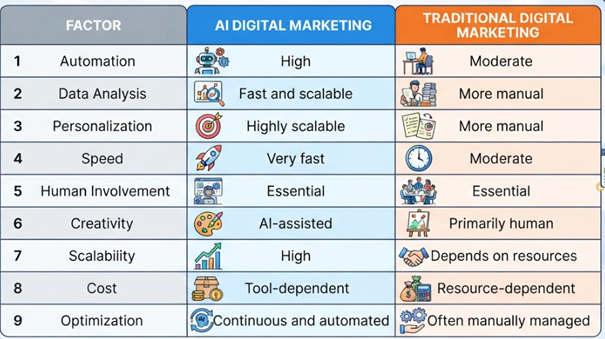
Neither approach is universally superior; their value depends on how effectively they match your operational scale.
Advantages of AI Digital Marketing
- Faster Marketing Processes: Instant asset generation, automated distribution, and real-time tweaks.
- Scalable Personalization: Delivering tailored user journeys to thousands of visitors simultaneously.
- Automated Repetitive Tasks: Freeing staff from administrative updates and routine data entry.
- Predictive Analytics: Identifying high-value leads and market shifts before competitors do.
- Improved Budget Efficiency: Automated reallocation of ad spend to top-performing assets.
Note: AI is an accelerator, not a strategy. It requires quality input data, brand guidelines, and expert human oversight to produce meaningful revenue outcomes.
Advantages of Traditional Digital Marketing
- Authentic Storytelling: Capturing deep human emotion and brand personality that builds lasting trust.
- Direct Strategy & Control: Full visibility over messaging nuances, avoiding algorithmic errors.
- High Strategic Flexibility: Quick adaptations to novel market scenarios that lack historical training data.
- Nuanced Audience Understanding: Navigating complex business-to-business relationships with empathy.
- Predictable Workflows: Proven frameworks built on established tools and team roles.
Which Is Better for Small Businesses?
For small businesses with tight budgets and lean teams, a hybrid model leveraging accessible AI tools yields the highest return.
Small teams can use AI for draft copywriting, routine customer support chatbots, and quick asset sizing—tasks that usually require dedicated staff. However, small businesses still rely heavily on traditional techniques like authentic founder storytelling, direct local community engagement, and relationship building.
AI handles the legwork; human touch closes the deal.
Which Is Better for Large Businesses?
Large enterprises benefit massively from AI-first execution frameworks governed by experienced human strategists.
Enterprise organizations handle vast data streams across multiple customer touchpoints. AI is necessary to manage cross-channel attribution, real-time ad buying, and continuous dynamic audience segment updates.
Enterprises leverage AI to maintain operational speed across regions, while executive teams retain oversight of overarching brand strategy and multi-channel creative direction.
When Should You Choose AI Digital Marketing?
AI-driven solutions are ideal when facing specific operational roadblocks:
- Scaling personal touches across large lead volumes.
- Managing complex, multivariate paid media campaigns across several platforms.
- Synthesizing vast amounts of behavioral analytics into actionable updates.
- Automating routine email workflows and customer service triaging.
- Accelerating initial creative output and ad variations.
When Should You Choose Traditional Digital Marketing?
Traditional human-led methods are essential for:
- Crafting core brand messaging, value propositions, and flagship content assets.
- Navigating sensitive, high-touch PR situations or crisis communications.
- Building high-ticket B2B account-based marketing campaigns.
- Creating original thought leadership that requires deep industry expertise.
- Establishing foundational market positioning.
Can AI and Traditional Digital Marketing Work Together?
Yes. The most effective digital marketing strategy is not an “either/or” decision, but an integrated hybrid framework.
Combining human strategy with computational scale unlocks maximum efficiency:
- Strategy & Ideation (Human): Defining target personas, overall campaign narratives, and unique positioning.
- Content Production (AI + Human): AI drafts frameworks and asset variations; human editors polish brand voice, verify facts, and add personal stories.
- Distribution & Analysis (AI): Automation platforms handle real-time ad bidding, segmentation, and performance tracking.
- Optimization (Human): Marketers review macro trends and refine overarching strategy based on system insights.
How to Build a Winning Digital Marketing Strategy in 2026
Step 1: Define Your Marketing Goals
Establish clear, numeric objectives (e.g., target CPA, pipeline growth, customer retention metrics) before investing in new methodologies.
Step 2: Understand Your Audience
Map out key customer touchpoints to identify where automated personalization helps, and where genuine human connection is required.
Step 3: Identify Repetitive Tasks
Audit team workflows to pinpoint time sinks—such as manual data extraction or routine post-scheduling—that can be handed off to software.
Step 4: Choose the Right Technology Stack
Select AI tools designed for your specific tech stack rather than acquiring isolated single-feature applications.
Step 5: Keep Human Oversight
Implement strict review protocols. Every piece of AI-generated content or strategic recommendation must pass through human quality checks to preserve accuracy and brand standards.
Step 6: Measure Results Continuously
Track meaningful metrics—such as customer acquisition cost, conversion rate improvement, and return on ad spend—rather than surface vanity metrics.
Common Mistakes Businesses Make With AI Marketing
- Deploying AI Without Clear Strategy: Treating software integration as a silver bullet for poor product-market fit.
- Publishing Unedited AI Content: Flooding channels with bland, generic text that dilutes brand authority.
- Neglecting Brand Voice Integrity: Allowing automated engines to output messaging disconnected from company values.
- Over-Automating Customer Touchpoints: Replacing essential human support with frustrating bot loops.
- Blindly Trusting Output Data: Failing to cross-check analytics for algorithmic hallucination or data bias.
- Tool Bloat: Purchasing complex platforms without dedicated internal team ownership.
The Future of AI vs Traditional Digital Marketing
The boundary between AI and traditional digital marketing will continue to fade. Key trends reshaping the landscape include:
- Predictive Customer Journeys: Real-time adaptation of web experiences before explicit intent signals are logged.
- Hyper-Personalized Content Engines: Dynamic landing pages that adapt tone, media, and social proof based on visitor profiles.
- Conversational Commerce: Automated dialogue agents capable of handling complex buyer queries directly within ad interfaces.
- Advanced Attribution Modeling: Multi-touch analysis that maps non-linear modern buying cycles effortlessly.
Future marketing success won’t belong exclusively to algorithms or purely traditional approaches—it will belong to teams that blend technical automation with human judgment.
Final Verdict: AI vs Traditional Digital Marketing
AI brings unmatched speed, data analysis, scale, and operational efficiency to modern marketing campaigns. Traditional digital marketing preserves the creative storytelling, strategic direction, and emotional resonance that convert audiences into loyal customers.
The most successful businesses do not choose one over the other. They build high-performing hybrid systems that utilize AI to handle repetitive workload while freeing creative teams to focus on strategy, narrative, and relationship building.
The future of digital marketing doesn’t belong to AI or humans alone—it belongs to businesses that know how to make both work together.
Frequently Asked Questions
Is AI marketing better than traditional digital marketing?
AI marketing excels at automation, data analysis, execution speed, and personalization at scale. Traditional digital marketing remains superior for high-level strategy, narrative depth, and authentic human connection. The optimal choice depends on your business goals and operational capabilities.
Is AI marketing cheaper than traditional digital marketing?
AI reduces long-term manual labor costs and execution time, but it requires upfront investments in software licenses, integration, and training. Traditional marketing relies heavily on labor and management costs. Total cost varies based on campaign scale and execution methods.
Can AI completely replace digital marketers?
No. AI automates execution, pattern identification, and asset drafting, but it lacks emotional intelligence, nuanced brand strategy, and creative judgment. Successful campaigns still require human supervision and direction.
Which is better for small businesses, AI or traditional marketing?
Small businesses benefit most from a balanced approach. AI helps small teams scale content production and automate routine tasks, while traditional strategies build authentic local brand equity and trust.
Will AI replace traditional digital marketing?
AI is transforming digital marketing channels rather than eliminating them. Core channels like SEO, content, and paid acquisition remain relevant, but their backend management relies increasingly on AI tools alongside human creative direction.