


Search is changing rapidly as users increasingly turn to AI platforms for answers, recommendations, research, and product discovery. I’m Saad Asif, the CEO of Directions Solutions, and in my experience of more than a decade, developing an effective AI Search Visibility Strategy helps businesses increase their chances of appearing across these modern, AI-powered search experiences.
This comprehensive guide explores seven practical strategies businesses can deploy to strengthen their digital presence in the evolving search ecosystem.
How LLM Crawler Optimization Works
Instead of focusing only on traditional rankings and blue links, brands now need to make their web properties easier for large language models (LLMs) and answer engines to discover, understand, evaluate, and reference.

Executing effective crawler optimization requires removing technical bottlenecks so automated agents can digest web assets efficiently.
- Verify Bot Access: Check server logs to confirm bots like GPTBot or PerplexityBot receive 200 OK status codes rather than 403 Forbidden errors.
- Optimize Load Efficiency: Serve clean, lightweight HTML pages so retrieval systems can process content without high resource consumption.
- Structure Data In-Line: Place key facts, definitions, and conclusions directly in the text payload rather than concealing them inside interactive elements.
7 Powerful AI Search Visibility Strategy Tactics
1. Make Your Website Easy for LLM Crawlers to Access
Technical accessibility forms the baseline of machine discoverability. If automated systems cannot fetch or render your pages efficiently, your content cannot be synthesized into real-time answers.
- Robots Directives: Ensure your robots.txt file permits access to relevant user-agents (e.g., GPTBot, PerplexityBot, ClaudeBot, Google-Extended).
- Clean Rendering: Avoid blocking content behind client-side JavaScript execution that slows or prevents crawler processing.
- Sitemap Hygiene: Keep XML sitemaps updated and submitted to ensure fast discovery of newly published assets.
Proper LLM crawler optimization eliminates technical barriers, ensuring retrieval systems process your primary pages without getting dropped or timed out.
2. Create Content That AI Systems Can Understand Easily
Generative engines process content through semantic chunks. Structuring your pages logically helps these systems extract key facts accurately.
Maintain clear heading hierarchies, place direct 1-2 sentence answers immediately under subheadings, and use bullet points or tables for itemized information to make parsing effortless for machines.
3. Strengthen Structured Data and Entity Signals
Schema markup acts as an explicit translator between your content and automated systems. Using structured data helps clarify business identities, product features, and organizational authority.
- Organization & Person Schema: Clearly define company leadership, brand names, and official digital properties.
- Product & Offer Schema: Provide explicit data on pricing, availability, ratings, and specifications.
- FAQ & Article Schema: Structure questions and answers so models can pull exact text blocks directly into conversational responses.
Implementing detailed schema makes it easier to get found by AI bots, reinforcing how your brand connects to broader industry entities.
4. Build Strong Topical Authority
AI models prioritize sources that demonstrate deep, consistent knowledge within a specific domain. Publishing isolated articles targeting single keywords is less effective than building interconnected topic clusters.
- Pillar Assets: Create comprehensive guides that cover broad industry topics thoroughly.
- Supporting Clusters: Produce detailed sub-topic articles that link logically back to the main pillar.
- Original Insights: Integrate proprietary data, case studies, and expert analysis that cannot be duplicated by generic content generators.
Establishing clear domain coverage signals to language models that your site is a primary reference point for that topic.
5. Optimize Content for Conversational Search
People phrase questions differently when speaking or typing into AI assistants compared to traditional search boxes.
Target natural, multi-turn prompt structures by creating dedicated Q&A sections and incorporating conversational phrasing directly into subheadings.
6. Strengthen Brand Authority and Trust Signals
LLMs rely heavily on off-site sentiment, digital consensus, and brand mentions to establish credibility before surfacing a business in generated answers.
- Author Expertise: Highlight author credentials, experience, and verifiable backgrounds.
- Digital Footprint: Maintain consistent business information across Wikipedia, Wikidata, industry review sites, and news platforms.
- Citations & Mentions: Earn unlinked brand mentions and media coverage from recognized industry outlets.
Building strong external trust signals reduces hallucination risk and encourages language models to cite your brand safely.
7. Monitor AI Search Visibility and Adapt
Managing an AI Search Visibility Strategy requires continuous monitoring as model architectures and retrieval pipelines evolve.
- Prompt Auditing: Periodically query AI platforms with target buyer prompts to track whether your brand is mentioned.
- Citation Tracking: Monitor web analytics for referral traffic originating from conversational platforms like Perplexity or ChatGPT.
- Competitor Benchmarking: Analyze which competitors are consistently cited in target queries and evaluate their content structure.
Adjust your content strategy based on real-time referral data and citation changes to maintain continuous market visibility.
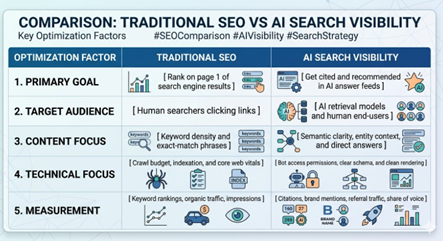
How to Get Found by AI Bots
Ensuring your business is reliably surfaced by automated discovery systems requires combining technical accessibility with clear information architecture.
- Maintain Consistent NAP Data: Ensure your Name, Address, and Phone number are uniform across all web directories.
- Publish Clear Entity Definitions: State explicitly what your company does, who it serves, and what products it offers on your primary About and Product pages.
- Eliminate Broken Links: Audit internal links regularly to keep crawlers moving through your site structure without hitting dead ends.
Content Strategies for the AI Search Landscape
Succeeding across the modern search ecosystem requires producing high-utility content that answers real user questions directly.
- Publish Original Research and Data
AI models frequently cite sources that provide unique, verifiable statistics. Conducting original industry surveys or publishing platform data makes your domain a primary citation source.
- Answer Specific Edge-Case Questions
Create content that addresses complex, long-tail scenarios. Models excel at synthesizing hyper-specific answers, and having clear coverage for niche questions increases your selection rate.
- Maintain Factually Current Pages
Outdated statistics reduce content reliability. Update pricing tables, feature lists, and industry stats regularly to signal freshness to retrieval systems.
How Advanced SEO Algorithms Affect AI Visibility
Modern search engines rely on sophisticated neural networks and machine learning models (such as Google’s RankBrain, MUM, and Gemini integrations) to process query intent. These algorithms look past literal keyword matches, analyzing semantic context, authoritativeness, and overall content helpfulness. Aligning your website with these systems ensures your content ranks well in traditional search while remaining primed for inclusion in generated answer summaries.
Common AI Search Optimization Mistakes
- Blocking LLM Crawlers: Accidentally restricting AI bots via robots.txt prevents models from indexing your latest content.
- Publishing Low-Quality AI Content: Mass-producing generic, unverified text dilutes site authority and hurts trust metrics.
- Ignoring Structured Data: Failing to use Schema markup forces models to guess entity relationships, increasing misinterpretation risks.
- Over-Complicating Text Formatting: Hiding important facts inside complex, multi-nested visual widgets makes extraction difficult for retrieval engines.
The Future of AI Search Visibility
Search technology will continue to move toward proactive, hyper-personalized answer delivery. Key developments to prepare for include:
- Multimodal Discovery: AI engines analyzing images, video transcripts, and audio files alongside text.
- Personalized Answer Feeds: Search outputs tailored dynamically to individual user histories and real-time contexts.
- Action-Oriented Search: AI agents executing tasks—such as booking, buying, or scheduling—directly within the search interface.
Building a flexible, standards-compliant web presence ensures your brand remains visible regardless of how front-end search interfaces evolve.
Conclusion
The rise of conversational search and answer engines is changing how information is discovered online. Implementing a comprehensive AI Search Visibility Strategy allows businesses to combine technical accessibility, structured data, clear content formatting, and entity authority to maintain market leadership.
Rather than viewing AI search as a disruption, forward-thinking organizations should treat it as an opportunity. By making your digital assets easy for machines to process and valuable for humans to read, you build a resilient web presence ready for the future of search.
Frequently Asked Questions
1. What is an AI Search Visibility Strategy?
An AI Search Visibility Strategy is a structured approach to optimizing web content so that AI-powered search engines, conversational bots, and answer engines can easily discover, understand, and cite your brand in their generated responses.
2. How can businesses improve visibility on AI engines?
Businesses can improve their visibility by opening access to LLM crawlers in robots.txt, applying structured Schema markup, structuring content with direct answers and clear headings, and earning authoritative brand mentions across trusted third-party websites.
3. What is LLM crawler optimization?
LLM crawler optimization involves technical adjustments—such as refining server response times, fixing crawl errors, updating site architecture, and managing robots directives—to ensure AI bots can fetch and process site content without friction.
4. How can a business get found by AI bots?
To get found by AI bots, publish clear entity information, maintain updated sitemaps, use structured data markups, ensure fast server rendering, and eliminate technical blockades like aggressive CAPTCHAs or misconfigured robots files.
5. Is AI search optimization replacing traditional SEO?
No. AI search optimization expands upon traditional SEO fundamentals. High technical performance, clear content structure, and strong domain authority remain essential for both traditional search engine indexing and AI-generated answer synthesis.