


Selecting a growth partner is one of the most critical decisions a financial technology company can make. I’m Saad Asif, the CEO of Directions Solutions, and in my experience of more than a decade, the right Marketing Agency for Fintech can turn advertising capital into a predictable pipeline of qualified users, active platform deposits, and long-term revenue. Conversely, the wrong choice leads to wasted budgets, missed compliance standards, and stagnant customer acquisition.
This comprehensive buyer’s guide breaks down seven actionable secrets to help fintech decision-makers evaluate, select, and manage a marketing partner capable of delivering measurable business performance.
How to Build a Strong Agency Onboarding Process
Fintech marketing operates in a significantly stricter environment than standard digital marketing. Financial products involve high customer friction, regulatory oversight, data privacy requirements, and complex customer journeys built heavily on user trust.

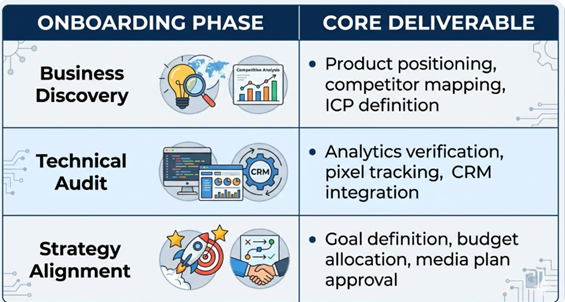
Once selected, ensure immediate momentum by structuring the initial 30 days around systematic alignment:
- Share Business Intelligence: Provide complete access to product documentation, ideal customer profiles, competitor lists, and past campaign performance data.
- Establish Technical Access: Grant appropriate permissions for web analytics, ad accounts, mobile measurement partners (MMPs), and CRM tools.
- Define Baseline KPIs: Formalize target benchmarks for CPQL, CAC, conversion rates, and monthly target volume before launching active spend.
- Establish Communication Standards: Set clear expectations for weekly status syncs, reporting formats, emergency contacts, and approval turnarounds.
7 Powerful Ways to Evaluate a Marketing Agency for Fintech
1. Check Their Fintech Industry Experience:
Verify whether an agency genuinely understands financial technology products or is simply applying generic consumer strategies. Look for documented experience across sub-sectors:
- Digital banking and neobanking platforms
- B2B and B2P payment processing gateways
- Wealthtech, robo-advisors, and personal finance apps
- Insurtech, lending infrastructure, and crypto platforms
2. Review Their Track Record and Previous Results.
Past campaign performance reveals how an agency operates under pressure. Demand clear case studies detailing measurable customer acquisition metrics, conversion rate improvements, and retention figures rather than top-of-funnel vanity metrics.
3. Evaluate Their Vendor Onboarding Process.
Professional agencies utilize a structured onboarding framework to absorb your product architecture, target audience profiles, and existing technical stacks quickly.
4. Check Their Performance Marketing Capabilities.
A capable agency must excel at performance marketing fintech execution. Ensure their team actively manages and optimizes paid search, paid social, programmatic retargeting, and dynamic landing page conversion systems to capture high-intent users.
5. Examine Their Reporting and KPIs.
Avoid agencies that report only on clicks, impressions, or follower growth. Your agency partner should report on revenue-connected metrics:
- Cost Per Qualified Lead (CPQL)
- Customer Acquisition Cost (CAC)
- Return on Ad Spend (ROAS)
- Trial-to-paid or install-to-registration conversion rates
6. Assess Their Compliance and Data Awareness.
Fintech campaigns require stringent adherence to privacy frameworks (GDPR, CCPA) and ad platform policy guidelines regarding financial services. Ensure your agency establishes formal approval workflows with your internal legal and compliance teams before assets go live.
7. Compare Communication, Strategy, and Long-Term Support:
Evaluate account management structures, meeting cadences, and optimization processes. Your agency should act as an extension of your internal growth team rather than an isolated vendor delivering static monthly assets.
How to Choose a Fintech Marketing Firm
When deciding on fintech marketing firm options for your organization, follow a structured internal selection roadmap:
- Define Business Goals: Clarify whether immediate priorities center on user acquisition, institutional lead generation, or brand repositioning.
- Establish Budget Frameworks: Define clear parameters for media spend versus agency retainer fees.
- Build an Evaluation Scorecard: Rate candidate agencies objectively against identical criteria during pitch presentations.
- Request Strategic Recommendations: Ask shortlisted candidates to analyze a sample friction point in your current funnel.
Vendor Evaluation Metrics Every Fintech Should Check
Utilize these core vendor evaluation metrics to rank agency proposals during final evaluations:
- Strategic Capability: Ability to connect top-of-funnel campaigns to long-term LTV goals.
- Technical Proficiency: Expertise in multi-touch attribution, server-side tracking, and conversion rate optimization (CRO).
- Industry Expertise: Direct understanding of user onboarding barriers, financial disclosures, and buyer trust drivers.
- Reporting Quality: Clear attribution showing how advertising spend directly drives registered users or funded accounts.
- Optimization Velocity: The speed and frequency at which the team tests new ad creatives, messaging angles, and landing pages.
Performance Marketing Fintech Strategies to Look For
A sophisticated performance marketing fintech framework combines targeted acquisition channels with systematic conversion optimization:
- High-Intent Search Advertising: Capturing active demand for specific financial tools, investment apps, and processing platforms.
- Targeted Paid Social: Leveraging LinkedIn for B2B fintech decision-makers and Meta/TikTok for consumer finance apps.
- Landing Page Conversion Optimization: Designing trust-focused landing pages optimized for seamless user registration.
- Automated Retargeting Funnels: Re-engaging users who dropped off during registration or KYC (Know Your Customer) verification steps.
- Conversion Tracking Infrastructure: Server-side tracking setup to pass accurate conversion signals back to ad platforms.
Red Flags When Selecting a Fintech Marketing Agency
Watch for these critical warning signs during vendor discussions:
- Guaranteed Results Without Audits: Promises of exact conversion numbers or impossibly low CACs before reviewing historical performance data.
- Lack of Relevant Case Studies: Absence of documented campaign outcomes in financial services or related tech sectors.
- Vague Pricing Structures: Lack of transparency regarding ad spend management fees versus creative production costs.
- Opaque Reporting: Inability to demonstrate how marketing activity directly influences pipeline, account funding, or revenue growth.
- No Compliance Protocol: Ignorance of financial ad policies, disclaimers, or data privacy rules across major advertising networks.
Questions to Ask Before Hiring a Marketing Agency
Pose these direct questions to candidate teams during pitch meetings:
- What specific financial products or fintech verticals have you managed previously?
- Which core metrics and KPIs do you track to measure campaign success?
- How do you qualify leads and confirm user intent before scaling budget?
- How do your account managers handle ad rejections or compliance updates on major platforms?
- Who will be managing our day-to-day campaign operations and account strategy?
- How frequently will our team receive performance reports and optimization updates?
- What is your process for testing new creative assets and landing page variations?
How to Compare Multiple Agencies
Assign weighted scores across core performance categories to evaluate competing proposals objectively:
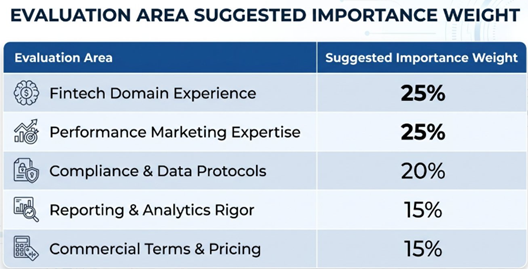
Evaluating partners on total value rather than initial price tags prevents costly campaign rework and protects your ad budget.
How to Measure Your Agency After Hiring
Continuous agency evaluation ensures long-term ROI. Schedule bi-weekly performance reviews to track campaign delivery against agreed business milestones, and conduct quarterly strategic audits to adjust channel allocation based on actual user LTV data.
Key monitoring metrics include:
- Lead and user registration quality
- Campaign conversion rates across each funnel stage
- Customer Acquisition Cost (CAC) trends over time
- Total pipeline contribution and user deposit metrics
Agency Selection Guides for Long-Term Fintech Growth
Consulting comprehensive agency selection guides helps ensure your growth partner can scale alongside your business. As your organization expands, a high-performing Marketing Agency for Fintech will evolve its services from initial user acquisition into full-funnel retention, organic search domination (SEO), brand positioning, content strategy, and international market expansion.
Treating the partnership as a long-term strategic alliance ensures your marketing infrastructure remains resilient through market shifts and regulatory changes.
Future of Fintech Marketing Agencies
The next generation of fintech growth will rely heavily on technological integration. Modern agencies must combine human strategic direction with advanced capabilities, including AI-driven creative personalization, predictive customer modeling, automated dynamic bidding, machine-learning attribution, and automated campaign optimization.
Agencies that successfully pair strategic financial knowledge with emerging marketing technologies will deliver the highest growth efficiency for scaling fintech platforms.
Conclusion
Selecting a Marketing Agency for Fintech requires a clear evaluation framework focused on technical capability, industry experience, and measurable business performance. By prioritizing compliance awareness, transparent KPI reporting, and structured onboarding, fintech leaders can establish a high-performing partnership that drives predictable, sustainable growth.
Investing time in a thorough evaluation process protects your marketing budget and builds a scalable acquisition engine capable of compounding long-term enterprise value.
Frequently Asked Questions
1. What should I look for in a Marketing Agency for Fintech? Look for a Marketing Agency for Fintech with verified experience in financial technology, strong performance marketing capabilities, transparent reporting tied to CAC and revenue, and robust compliance workflows. It should also provide a structured onboarding plan and clear KPI frameworks.
2. How do I choose a fintech marketing firm? To choose fintech marketing firm partners effectively, define your growth goals, create a standardized agency evaluation scorecard, review past fintech case studies, and audit their technical capabilities across tracking and attribution before signing contracts.
3. Why should I work with a specialized finance agency? A specialized finance agency brings immediate domain expertise, pre-vetted compliance protocols, and a clear understanding of financial customer psychology, reducing onboarding time and mitigating regulatory risks compared to generalist agencies.
4. Which vendor evaluation metrics should fintech companies track? Key vendor evaluation metrics include Customer Acquisition Cost (CAC), Cost Per Qualified Lead (CPQL), conversion rates across registration/KYC steps, campaign attribution accuracy, and total pipeline or revenue contribution.
5. What is performance marketing fintech? Performance marketing fintech refers to data-driven marketing strategies focused on driving trackable user actions—such as app installs, account registrations, loans funded, or platform deposits—with measurable return on ad spend.