


Business owners in Dubai and Abu Dhabi invest heavily in online marketing to drive traffic to their digital platforms. But driving traffic is only half the battle when poor website UX design in the UAE makes potential clients leave before converting.
I’m Saad Asif, the CEO of Directions Solutions, and in my experience, many of the region’s brand websites are beautiful on the surface but don’t deliver when visitors attempt to engage. Often, high bounce traffic is caused by small roadblocks in the buyer journey. Visitors who are confused or frustrated will immediately go to competitor sites.
Knowing these friction points can help to make a better UI/UX design for business leaders improve the user experience and preserve valuable traffic. This is where the big pain points in the UX are hurting lead generation across regional platforms.
Slow Page Loading Speeds and Delayed Interactions
A Poor Website UX design slows load speeds and destroys campaign performance faster than almost any other technical problem. Online visitors in the Emirates expect instant responses and fluidity from one web page to the next.
• Large images and big graphic elements increase the server response time.
• Heavy scripts without delay element rendering through asynchronous loading on mobile phones.
• Third-party plugins that are not properly cached can create performance bottlenecks.
We optimise asset delivery to render pages in under two seconds. Fast-loading sites hold the attention of consumers, reduce bounce rates, and skyrocket the initial inquiry rates.
Complex Form Designs and Form Abandonment Causes
A Poor Website UX design costs massive revenue loss for modern digital brands through Form abandonment. Up-front unnecessary details cause potential clients to hesitate and abandon the submission halfway through.
• Users are put off filling long inquiry forms with mandatory phone and physical address fields.
• Unhelpful error messages when validating form fields, leaving users confused about how to rectify errors.
• No quick autofill support leads to unnecessary typing on small screens.
Lead generation forms that simply ask for a name and e-mail address can increase the volume of conversions. You can always get more details later in the sales funnel.
Confusing Visual Hierarchy and Navigation Layouts
Visual hierarchy directs the eye to key messages and action steps. Poor website UX design decisions overwhelm users by giving secondary information equal visual weight.
• Lack of primary call to action buttons confuses next steps.
• Navigation menus are packed and bury important service pages under obscure labels.
• Poor text contrast choices make reading difficult on mobile displays in bright sunlight.
A clean layout helps users focus on clear conversion goals with ease. Strategic visual focus guarantees that every visitor knows exactly how to get in touch.
Mobile First Reality Check for Conversion UX Dubai
In the Emirates, most of the online browsing is on mobile devices. Conversion UX Dubai standards dictate a distinct mobile strategy rather than a scaled-down desktop site.
Designing for mobile requires different layout decisions to account for thumb navigation and short attention spans. If you’re not optimising for mobile due to poor website UX design, you’re missing out on the majority of active local consumers.
Thumb Friendly Touch Targets and Button Placement
Mobile screens need touch controls that match the natural movement of the thumb. Small buttons packed too close together lead to misclicks and user annoyance.
• Put main navigation controls in the lower part of mobile screens within easy thumb reach.
• Interactive buttons should have generous padding so users can tap accurately without zooming.
• Sticky call options allow users to make calls or message on the fly.
Controls are designed to be easily operated with one hand and provide a comfortable experience that prompts immediate action.
Streamlined Content Modules for Small Screens
Long blocks of text on handheld devices cause fatigue for the reader, a common problem in poorly designed websites. Bite-sized pieces of information with clear visual breaks are what mobile users like.
• Short paragraphs make content easier to read—and keep users on the page as they scroll.
• Bullet points communicate the key benefits quickly and do not take up screen space.
• Collapsible section blocks enable users to dive into details without too much vertical scrolling.
The content on mobile needs to be structured for easy scanning so that people can find answers fast and convert without wasting time.
Trust and Credibility Signals That Matter
Establishing immediate authority and credibility is one big factor in conversion success. In a competitive market, online users want some reassurance before they give out personal contact information or ask for business proposals.
Strong trust signals embedded throughout every landing page UX build confidence from the moment a user lands.
Local Social Proof and Client Testimonial Integration
Local buyers like to hear genuine feedback and know the client relationships they have. Sharing real stories of success establishes immediate trust.
• Prominent client logo display strips demonstrate industry authority and operational scale.
• Video testimonials from well-known local brand leaders carry a lot of weight.
• Clear case studies demonstrate delivered, proven business results and ROI.
Placing social proof in and around lead inquiry forms directly addresses buyer objections at the moment of action.
Regional Compliance, Security Badges, and Bilingual Support
Technical safety and cultural fit are also trust signals. UAE audiences need clear signals that their private data is secure.
Technical safety is confirmed by SSL encryption badges and secure payment icons.
• Visible privacy policies tell users their personal data won’t be shared.
•Fluid switching between Arabic and English shows respect for the region and commitment to the market.
Language compliance and data security ensure all demographic groups feel comfortable interacting with your platform.
Accessibility and Arabic RTL Considerations
For a truly inclusive web experience across the UAE market, you need to look very carefully at your site architecture in both languages. Arabic right-to-left translation is not just a matter of reversing the order of text.
Good RTL design is about mirroring the layout structures, visual paths, and interactive elements in a way that feels natural for Arabic readers.
Alignment and Layout Mirroring Rules
When switching from English to Arabic, the visuals need to be adjusted properly to keep the flow of reading intuitive. If the website has a bad UX design, it can hamper the flow of reading.
• The page header will have the main navigation items and logo swapped.
• Form field labels and input prompt text align to the right side, seamlessly.
• Call to action arrow icons change direction to match the new reading direction.
A well-designed RTL implementation guarantees the same high-quality experience for Arabic users as for English visitors.
Typography and Font Readability in Arabic Design
Arabic script requires special font and spacing adjustments to remain readable on digital screens.
• Choosing modern web fonts that are designed for digital screens can help avoid visual clutter.
• A slight increase in line height provides clean vertical breathing room between Arabic characters.
• Appropriate font weight keeps subheadings readable and visually separate.
By refining typography, you help to avoid poor website UX design, creating an inviting reading experience that honours regional culture while supporting commercial conversion goals.
Quick Wins vs Structural Fixes for Your Website
Remediating user experience shortcomings requires balancing immediate quick wins with comprehensive structural redesigns to avoid poor website UX design. Knowing where to start helps marketing teams maximize initial ROI.
Implementing quick adjustments provides immediate performance lifts, while structural overhauls ensure long-term competitive advantage.
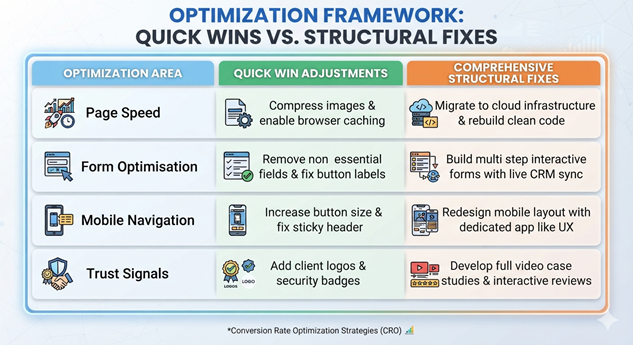
Combining fast tactical fixes with strategic architectural upgrades guarantees sustained growth in digital inquiries.
Transform Your Digital Results with Directions
By removing friction from the user experience, you turn existing traffic into a predictable engine of business growth. Improve your platform layout, your speed, your messaging – all of which directly improve lead generation and campaign return on investment.
Directions empowers regional businesses to build high-powered digital platforms that wow visitors and turn them into customers.
Frequently Asked Questions
Why is website UX design UAE so critical for lead generation in 2026?
Competition digitally in all the Emirates is at its peak. Online users demand lightning-fast performance, seamless mobile interactions, and instant clarity. If your site has friction or bad website UX design, visitors will leave your site right away for your competitors, costing your business valuable leads and direct revenue.
How do mobile UX best practices influence conversion rates in Dubai?
The majority of regional web traffic comes from mobile devices. By adhering to mobile UX best practices, you can ensure your site has thumb-friendly navigation, clear fonts and fast forms. Optimising for handheld browsing is effective in converting casual mobile visitors into qualified sales leads.
What are the main form abandonment causes on corporate websites?
Forms that ask for too much personal information upfront or don’t provide clear validation guidance often see user abandonment. Users abandon submissions before completion because of long fields, lack of mobile responsiveness, and confusing error messages. Simplifying forms is good for conversion momentum.
Why are Arabic RTL considerations vital for regional digital platforms?
A large section of the local market likes to browse in Arabic. A broken user experience when flipping text without changing layout structure, icons, and typography. RTL-dedicated design is culturally relevant and captures market share among Arabic-speaking audiences.
How quickly can improving landing page UX increase business leads?
Quick win adjustments like compressing images, easier forms, and clearer call to action buttons can lead to noticeable lead lifts within days. Structural overhauls provide long-term sustained exponential conversion growth.